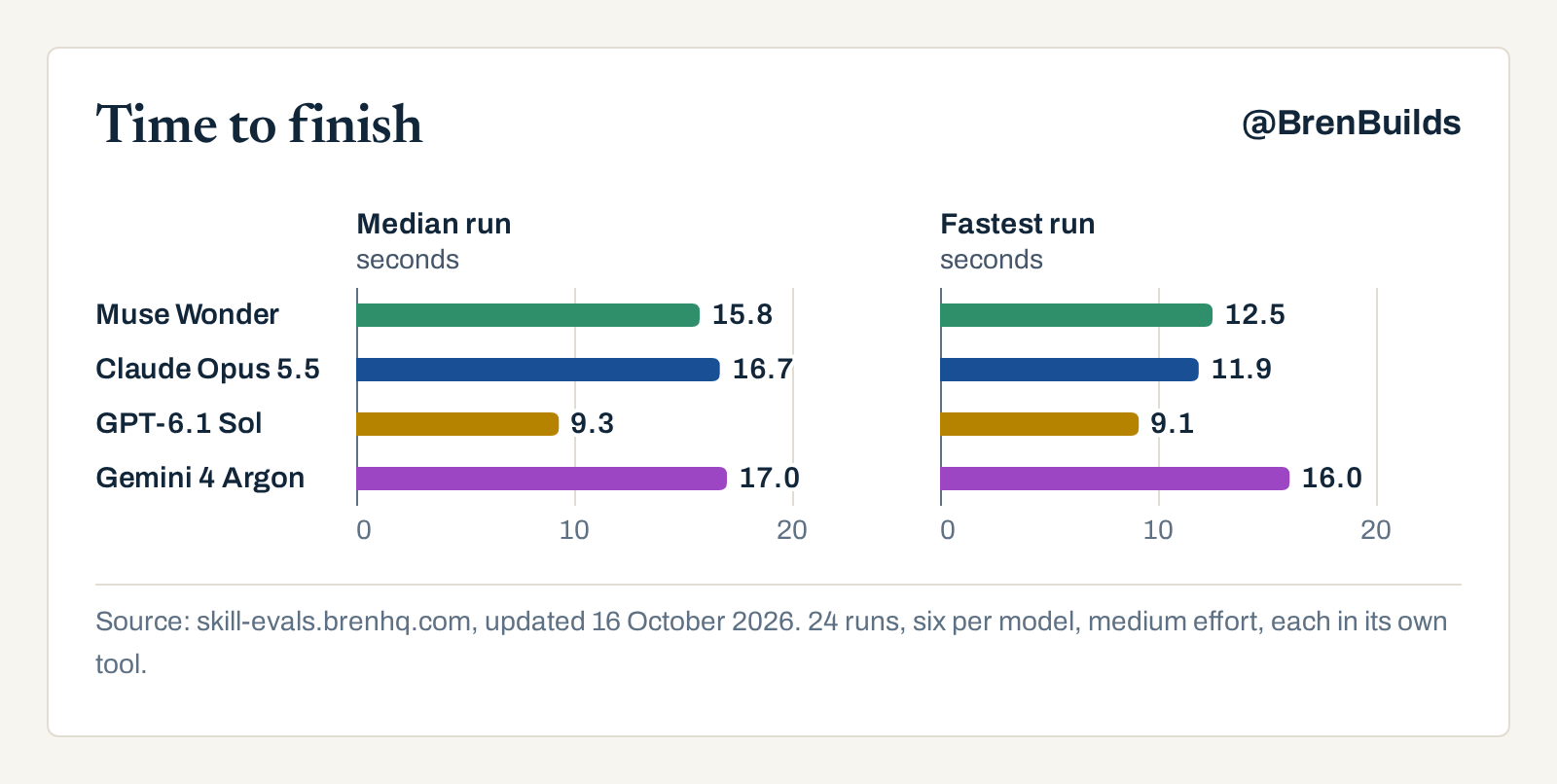
On one explain task, Muse Wonder was slower than GPT-6.1 Sol and about as fast as Claude Opus 5.5 and Gemini 4 Argon.
On 16 October I ran Meta's Muse Wonder through my launch suite in Cursor CLI, next to Claude Opus 5.5, GPT-6.1 Sol and Gemini 4 Argon. Meta released it on 12 October. This is Muse Wonder, not Muse Wonder Full.
Speed#
On one explain task, Muse Wonder was slower than GPT-6.1 Sol and about as fast as Claude Opus 5.5 and Gemini 4 Argon. A typical run: GPT-6.1 Sol 9.3 s, Muse Wonder 15.8 s, Claude Opus 5.5 16.7 s, Gemini 4 Argon 17.0 s.
One short explain task, start to finish, the four models taking turns. Hover or tap a row for every run.
One Gemini 4 Argon run took 129.2 s. The typical run is the median, so it barely moves it.
| Model | Tool | Run 1 | Run 2 | Run 3 | Run 4 | Run 5 | Run 6 |
|---|---|---|---|---|---|---|---|
| Muse Wonder | Cursor CLI | 27.0 s | 12.5 s | 13.7 s | 15.8 s | 15.7 s | 16.4 s |
| Claude Opus 5.5 | Claude Code | 16.4 s | 19.4 s | 18.5 s | 11.9 s | 16.9 s | 16.4 s |
| GPT-6.1 Sol | Codex CLI | 9.8 s | 9.1 s | 9.3 s | 9.3 s | 9.2 s | 11.7 s |
| Gemini 4 Argon | Cursor CLI | 17.4 s | 16.7 s | 129.2 s | 16.3 s | 16.0 s | 26.0 s |
The table scrolls sideways on a small screen.
Source: skill-evals.brenhq.com, updated 16 October 2026. 24 runs, six per model, medium effort, each in its own tool.
TPS#
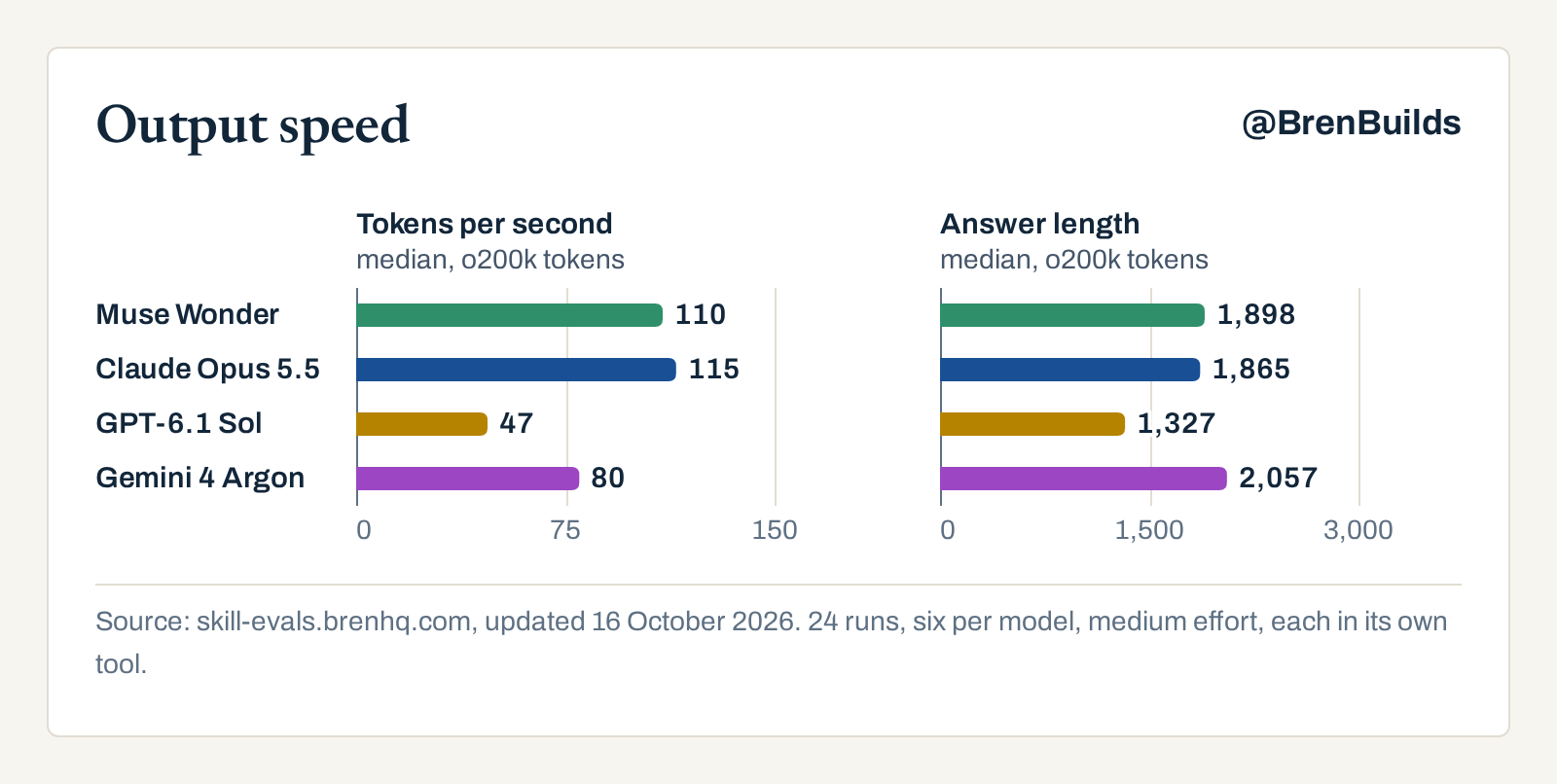
Muse Wonder streamed its answers about as fast as Claude Opus 5.5, usually faster than Gemini 4 Argon and faster than GPT-6.1 Sol. Typical answer-stream TPS: Claude Opus 5.5 115, Muse Wonder 110, Gemini 4 Argon 80, GPT-6.1 Sol 47.
A walkthrough of at least 600 words on the same file, the four models taking turns. Hover or tap a row for every run.
TPS is answer tokens per second, from the first answer token to the last, so start-up, reading the file and thinking are left out. All four are counted with OpenAI's o200k tokenizer, because Cursor only reports tokens for a whole session. Anthropic counts Opus 5.5's answers as about 1.4 times as many tokens. Every run passed and streamed, so all of them count.
Source: skill-evals.brenhq.com, updated 16 October 2026. 24 runs, six per model, medium effort, each in its own tool.
The race#
- Muse Wonder: 12.5 to 27.0 s
- Claude Opus 5.5: 11.9 to 19.4 s
- GPT-6.1 Sol: 9.1 to 11.7 s
- Gemini 4 Argon: 16.0 to 129.2 s
Cost#
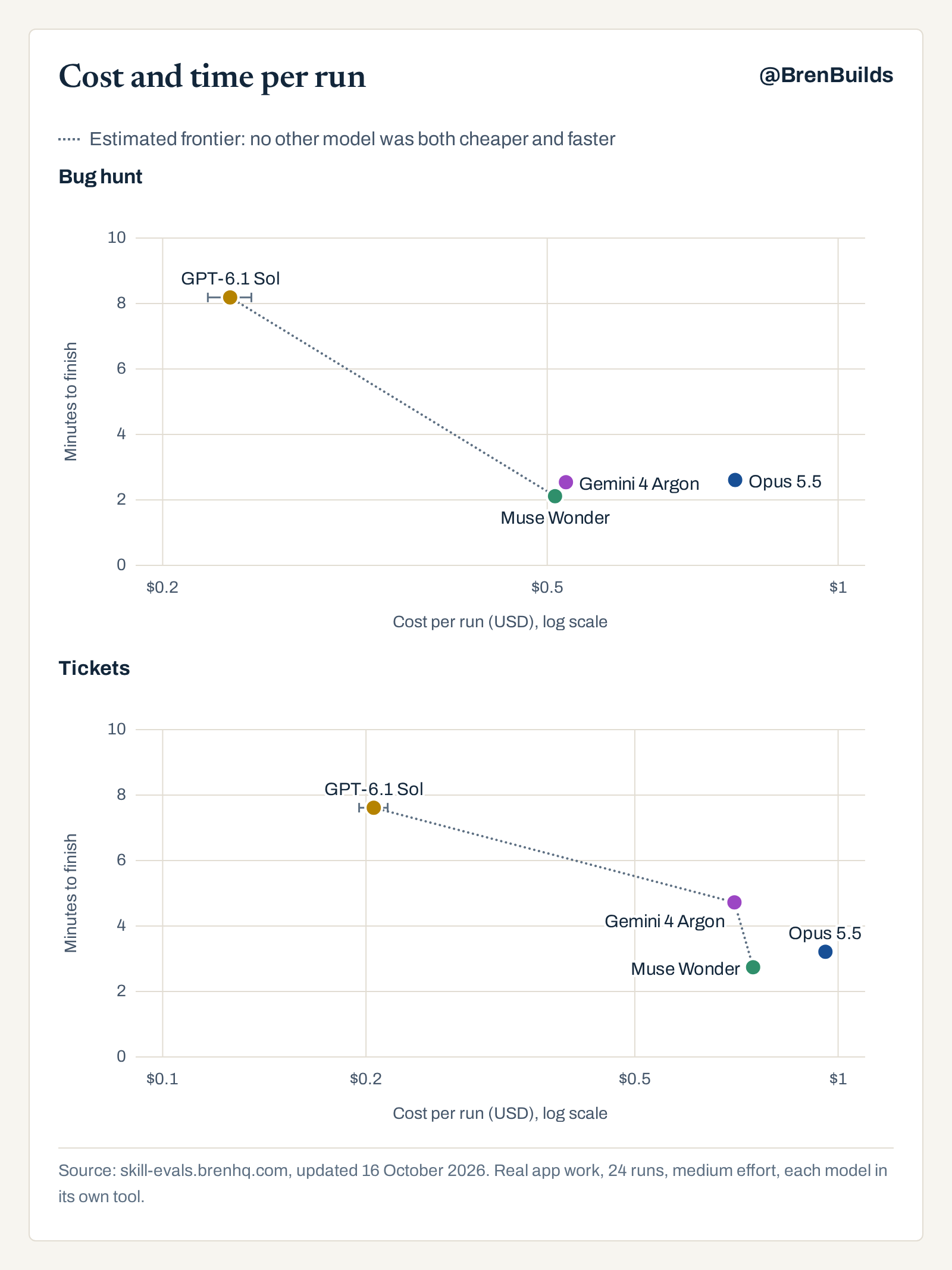
On both real-work tests, Muse Wonder cost less than Claude Opus 5.5 at the same list prices and finished sooner; GPT-6.1 Sol cost least but took 2.8 to 3.9 times as long as Muse Wonder.
Each dot is a model's median run, three runs each. Every run scored full marks, so this shows cost and time only. Costs are list-price estimates from each run's tokens.
- Estimated frontier: no other model was both cheaper and faster
Lower left is cheaper and faster.
Bug hunt
Sprint tickets
Muse Wonder and Opus 5.5 have the same list prices. Most of the gap is Opus 5.5's cache writes, 53,000 to 58,000 tokens a run at twice its input price. Cursor reports none for Muse Wonder. Muse Wonder also wrote fewer output tokens, 13,000 to 18,000 a run to Opus 5.5's 16,000 to 21,000.
Source: skill-evals.brenhq.com, updated 16 October 2026. Real app work, 24 runs, medium effort, each model in its own tool.
Every check#
The same checks for all four.
| Check | Muse Wonder | Claude Opus 5.5 | GPT-6.1 Sol | Gemini 4 Argon |
|---|---|---|---|---|
| Four small coding tasks, every setup: runs that passed | 60 of 60 | 60 of 60 | 60 of 60 | 60 of 60 |
| ASD-STE100 instruction on the explain task: runs that passed | 3 of 3 | 3 of 3 | 3 of 3 | 3 of 3 |
| Bug hunt: bugs fixed of 20, each run | 20, 20, 20 of 20 | 20, 20, 20 of 20 | 20, 20, 20 of 20 | 20, 20, 20 of 20 |
| Bug hunt: runs that edited the existing tests | 0 of 3 | 0 of 3 | 0 of 3 | 1 of 3 |
| Bug hunt: cost per run at list prices, median | $0.51 | $0.78 | $0.22 to $0.25 | $0.52 |
| Sprint tickets: hidden checks passed, each run | 17, 17, 17 of 17 | 17, 17, 17 of 17 | 17, 17, 17 of 17 | 17, 17, 17 of 17 |
| Sprint tickets: cost per run at list prices, median | $0.75 | $0.96 | $0.20 to $0.22 | $0.70 |
The table scrolls sideways on a small screen.
Every run counts. A run that edits an existing test fails, whatever else it fixed. Runs from Muse Wonder 16 October, Claude Opus 5.5 22 to 30 September, GPT-6.1 Sol 29 to 30 September and Gemini 4 Argon 13 October, 2026.
How I ran it#
Background and method
Muse Wonder and Gemini 4 Argon ran in Cursor CLI 2026.10.01-e373342 as Cursor's medium versions, Claude Opus 5.5 in Claude Code 2.1.284 and GPT-6.1 Sol in Codex CLI 0.159.0, all at medium effort. All four ran in Docker on my subscriptions, with no API keys.
Speed is the whole run on one short explain task, from starting the tool to its exit, so it includes start-up. A run passes when the answer names the month logic and the ValueError.
TPS comes from a separate sitting, a 600-word walkthrough, six runs each. I saved each answer, counted it with OpenAI's o200k tokenizer and divided by the seconds from its first answer token to its last. Claude Code's tokens were timed at a local proxy, Codex's on its WebSocket and Cursor's on its own stream, so buffering can shift the rates. OpenAI's own count for Sol's answers is within 0.5% of the o200k count. A median needs three runs that count.
The checks are four small coding tasks with no skill, a placebo file and three token-saving skills, three runs each; the ASD-STE100 instruction on the explain task; and a bug hunt with 20 planted bugs and three sprint tickets in a small TypeScript app, graded by hidden tests. Opus 5.5, Sol and Argon use their published runs of the same tasks.
Costs are list-price estimates from each run's tokens. Muse Wonder is $4 per million input tokens, $0.20 cached and $20 output, the same as Claude Opus 5.5, and Meta lists no cache-write price. Gemini 4 Argon is $2, $0.10 and $10 until 30 November 2026, then double. Opus 5.5's cost includes cache writes at twice its input price. Sol's is a range because Codex logs no cache writes. This is not what the runs cost me.
The run records are in results.json, under launch28_timing, launch28_runs and launch28_real_runs, with Gemini 4 Argon's under launch27_runs and launch27_real_runs, and Opus 5.5's and GPT-6.1 Sol's under runs, ste_runs and bughunt_runs.